World Monitor vs. Traditional Intelligence Tools: Why Free and Open Source Wins
A Bloomberg Terminal costs $24,000 per year. A Palantir deployment starts in the millions. Dataminr licenses run six figures for enterprise teams. Recorded Future isn’t cheap either.
These tools are powerful. They’re also gatekept behind budgets that exclude most of the world’s analysts, researchers, journalists, and security professionals.
World Monitor asks a different question: what if the intelligence dashboard was free?
The Comparison
Let’s be direct about what World Monitor is and isn’t relative to established platforms.
World Monitor vs. Bloomberg Terminal
Bloomberg wins at:
- Depth of financial data (tick-level, decades of history)
- Trading execution and order management
- Fixed income and derivatives pricing
- Proprietary analyst research
- Terminal-to-terminal messaging
World Monitor wins at:
- Geopolitical intelligence integration with market data
- Conflict and military monitoring (Bloomberg has zero)
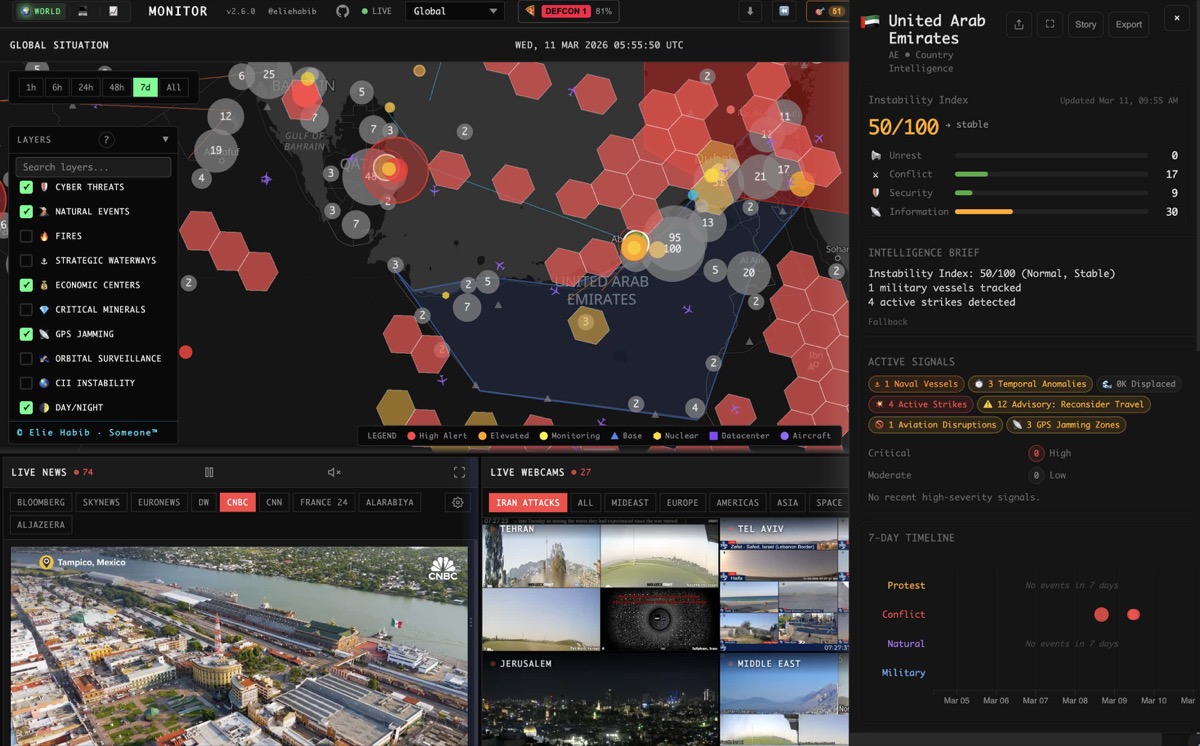
- Visual map-based interface with 45 data layers
- AI analysis that runs locally (Bloomberg’s AI is cloud-only)
- Price: free vs. $24,000/year
- Open source transparency
Best for: Traders who need geopolitical context for macro positioning, not tick-level execution.
World Monitor vs. Palantir Gotham/Foundry
Palantir wins at:
- Ingesting proprietary organizational data
- Custom ontology building
- Classified network deployment
- Workflow automation at enterprise scale
- Dedicated engineering support
World Monitor wins at:
- Zero deployment time (open a browser)
- No vendor lock-in (AGPL-3.0 source code)
- Public OSINT aggregation out of the box
- Self-service without enterprise contracts
- Community-driven development
- Price: free vs. multi-million dollar contracts
Best for: Analysts who need public OSINT aggregation today, not a 6-month enterprise deployment.
World Monitor vs. Dataminr
Dataminr wins at:
- Proprietary social media firehose access (Twitter/X partnership)
- Purpose-built alerting and notification workflows
- Dedicated analyst support
- Enterprise SLA and compliance certifications
World Monitor wins at:
- Broader intelligence scope (Dataminr focuses on social; World Monitor covers military, maritime, aviation, markets, infrastructure)
- 26 Telegram OSINT channels (Dataminr has limited Telegram coverage)
- AI analysis with local LLM option
- Interactive map visualization
- No vendor dependency
- Price: free vs. six-figure annual licenses
Best for: Analysts who need multi-domain intelligence, not just social media monitoring.
World Monitor vs. Recorded Future
Recorded Future wins at:
- Deep dark web and threat intelligence collection
- Malware analysis and IOC correlation
- Vulnerability intelligence
- Dedicated threat analyst team
- Enterprise integration ecosystem (SIEM, SOAR)
World Monitor wins at:
- Geopolitical and military intelligence (Recorded Future focuses on cyber)
- Financial market integration
- Interactive visual map interface
- Local AI processing
- Real-time conflict and disaster monitoring
- Price: free vs. enterprise licensing
Best for: Analysts who need geopolitical intelligence alongside cyber threat data.
The Real Advantage: Multi-Domain Fusion
The fundamental difference isn’t any single feature. It’s that World Monitor fuses domains that traditional tools keep separate:
| Domain | Bloomberg | Palantir | Dataminr | Recorded Future | World Monitor |
|---|---|---|---|---|---|
| Financial markets | Deep | Limited | No | No | Moderate |
| Geopolitical events | Limited | Custom | Social only | Cyber focus | Deep |
| Military tracking | No | Custom | No | No | ADS-B + AIS + USNI |
| Conflict data | No | Custom | Social | Cyber | ACLED + UCDP + Telegram |
| Infrastructure mapping | No | Custom | No | Partial | Cables, pipelines, ports, datacenters |
| Natural disasters | No | Custom | Limited | No | USGS + NASA FIRMS + EONET |
| AI analysis (local) | No | No | No | No | Ollama + LM Studio + browser ML |
| Prediction markets | No | No | No | No | Polymarket integration |
| Price | $24K/yr | $1M+ | $100K+ | Enterprise | Free |
| Open source | No | No | No | No | AGPL-3.0 |
No single traditional tool covers all these domains. Analysts typically cobble together 5-6 subscriptions. World Monitor provides integrated coverage across all of them. For a deeper dive into the market intelligence capabilities, see Real-Time Market Intelligence for Traders.
What World Monitor Doesn’t Do
Transparency matters. Here’s what you won’t get:
- Proprietary data: World Monitor uses public sources. If data requires private agreements (Twitter firehose, dark web crawlers, classified networks), it’s not here.
- Enterprise features: No SSO, RBAC, audit trails, or compliance certifications. It’s a dashboard, not a platform.
- Historical depth: Financial data doesn’t go back decades. Most data reflects the recent past and present.
- Trading execution: You can’t place orders. It’s intelligence, not a brokerage.
- SLA guarantees: It’s open source. The community and contributors maintain it, not a support team.
- Custom data ingestion: You can’t connect your proprietary databases. It works with its curated public sources.
When World Monitor Is the Right Choice
You should use World Monitor if:
- You need a multi-domain intelligence overview and your budget is limited
- You want geopolitical context alongside market data
- You need AI analysis that runs privately on your hardware
- You want to understand what tools like Bloomberg don’t show: military movements, conflict escalation, infrastructure exposure
- You’re a developer who wants typed APIs and open source to build on
- You want to evaluate intelligence tooling before committing to enterprise contracts
You should look elsewhere if:
- You need tick-level financial data for high-frequency trading
- You need dark web threat intelligence
- You need enterprise compliance (SOC2, FedRAMP)
- You need to ingest proprietary organizational data
- You need guaranteed SLAs and dedicated support
The Open Source Moat
Traditional intelligence vendors protect their value with proprietary data and closed algorithms. World Monitor inverts this: the value is in the integration, not the lock-in.
Every scoring algorithm is auditable. Every data source is documented. Every API contract is typed in Protocol Buffers. This means:
- Security teams can verify there are no backdoors or data exfiltration
- Researchers can reproduce and cite the scoring methodologies
- Developers can build custom integrations using the 22 typed API services
- Organizations can self-host for complete control. See the Developer API and Open Source guide for integration details.
The AGPL-3.0 license ensures that improvements to the core platform benefit everyone. Forks must also be open source. The commons stays common.
21 Languages, Global Access
Intelligence shouldn’t be English-only. World Monitor supports 21 languages with:
- Fully localized interface including RTL for Arabic
- Language-specific RSS feeds
- AI analysis in your preferred language
- Native character support for CJK languages
This means analysts worldwide can use the tool in their working language, not just as a translation layer over English sources. Read the full breakdown in World Monitor in 21 Languages.
Frequently Asked Questions
Can World Monitor replace a Bloomberg Terminal? For geopolitical intelligence, conflict monitoring, and macro context, yes. For tick-level financial data, derivatives pricing, and trade execution, no. World Monitor complements Bloomberg by covering domains Bloomberg does not touch, such as military tracking, conflict escalation, and infrastructure mapping.
Is World Monitor secure enough for professional use? The entire codebase is open source under AGPL-3.0, so security teams can audit every line. AI analysis can run fully offline via local LLMs. No data is collected, and no login is required.
What does “multi-domain fusion” mean in practice? It means seeing how a conflict zone overlaps with an undersea cable, how a naval repositioning affects shipping routes, or how a protest spike correlates with a currency move. Traditional tools silo these domains; World Monitor layers them on a single map.
Compare for yourself at worldmonitor.app. Free, open source, and ready in seconds.